

Table of Contents
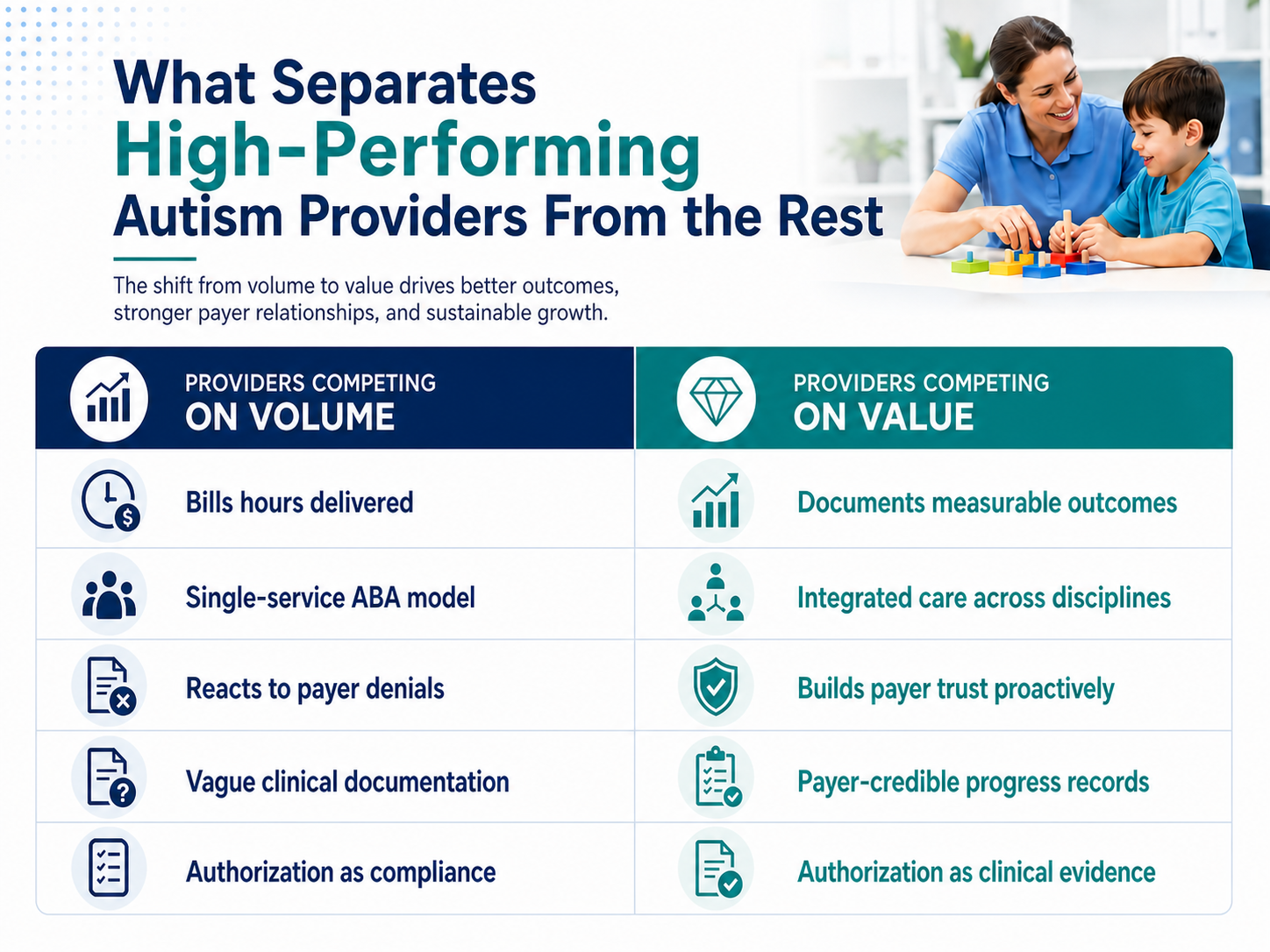
The autism services industry built itself on capacity. More clinicians. More locations. More hours of ABA delivered.
For a long time, that was enough.
It isn’t anymore.
Payer expectations are shifting. Families are asking sharper questions. Authorization reviewers are looking more closely at whether services are producing measurable clinical progress, not just showing up on a schedule.
The providers entering those conversations with evidence are in a different position than those entering with paperwork.
We spoke with three executives leading high-performing autism organizations. Their message is consistent: the next five years will separate providers built on outcomes from those still competing on volume alone.
What Is Changing Right Now?
Payers are raising the bar on clinical justification across the board.
- Utilization reviewers want documented proof of measurable progress
- Authorization renewals that once moved smoothly now require stronger clinical evidence
- Families are more informed and asking harder questions about outcomes
Providers who don’t have the infrastructure to capture and communicate clinical results are not just at risk in payer negotiations. They are increasingly at risk in the market.
What 3 Autism Care Executives Are Saying?

The core point: Payers are no longer satisfied with authorization compliance. They want proof that children are better off because of the services they funded.
Spink’s position is direct: organizations that treat data as a clinical asset are entering payer conversations from a position of strength. Those that don’t are entering with billing records.
What Autism Care Partners is building around:
- Consistent outcome measurement tools across the organization
- Disciplined clinical documentation tied to payer-recognized criteria
- A culture where tracking progress is part of delivering care, not separate from it
The difference between those two operational postures, Spink argues, shows up in contract renewals. And it is not a small difference.
The core point: ABA therapy alone is no longer a sufficient value proposition. The providers most exposed right now are those built entirely around a single service line.
Semmel asks a question every autism provider should be able to answer specifically: Why you, over every other option in your market?
That answer has to be grounded in data, not positioning.
What Acorn Health is focused on:
- Building integrated care models that include speech therapy, occupational therapy, and behavioral health support
- Developing a clinical value proposition payers can evaluate against documented outcomes
- Creating payer relationships based on performance, not just compliance
The rationale is simple. Autism does not present in isolation. Providers who can address the full clinical picture are meeting families where they actually are.
The core point: Delivering good care and being able to prove you deliver good care are two different organizational capabilities. Future-ready providers are building both.
Gromacki is direct about the risk of cutting operational costs without investing in documentation infrastructure. Short-term savings, long-term exposure.
What Lighthouse Autism Center is investing in:
- Systems that consistently generate payer-credible evidence of clinical effectiveness
- Documentation frameworks written in language reviewers actually use
- Processes that make outcomes communication proactive, not reactive
When records consistently reflect measurable progress, authorization conversations run differently. When they are vague or templated, friction builds across every interaction.
Strong Clinical Outcomes Start With a Strong Revenue Cycle
BehavioralProz works with autism and behavioral health organizations to build the operational infrastructure that supports sustainable growth. From ABA billing and credentialing to prior authorization management and denial recovery, we handle the revenue cycle so your clinical teams can focus on what they measure best.
What All Three Are Doing Differently?
Despite leading organizations of different sizes and models, Spink, Semmel, and Gromacki are making the same category of investment.
Outcomes as a strategic asset: Collecting, analyzing, and communicating clinical data proactively to payers, families, and referral sources.
Beyond single-service models: Building care coordination across disciplines so families receive a complete clinical response, not isolated services.
Payer relationships built on track record: Moving from authorization compliance to documented performance. Organizations with that track record negotiate from a different position.
What the Next Decade of Autism Services Looks Like?
The autism organizations that define the next decade will not be the ones that treated the most hours.
They will be the ones that:
- Built clinical infrastructure to prove what those hours produced
- Created service models that meet children and families as whole people
- Earned payer trust through consistent, documented performance
What Spink, Semmel, and Gromacki are describing is an industry growing up. The providers that grow with it will be defined by outcomes, transparency, and integrated care.
The ones that don’t will find the market considerably less forgiving than it used to be.