

Streamlined Prior Authorization and Insurance Verification
If you’re on a journey to recovery from opioid use, you already know how crucial timely access to Medication-assisted opioid treatment is. However, the barriers standing in your way, like the limited availability of treatment providers and the challenges of prior authorization, can feel overwhelming. It’s not just in your head, these issues are very real, and they’re affecting people across the country.
A recent report from the Office of Inspector General (OIG) highlights a concerning issue: many people like you are being denied or delayed access to medication-assisted opioid use disorder treatment (MOUD) because of complicated administrative processes and a lack of available providers. Let’s break down what’s happening, how it affects your access to care, and what can be done to speed things up so you can get the Medication-assisted opioid treatment you need.
The Shortage of Providers: Fewer Doors to Walk Through
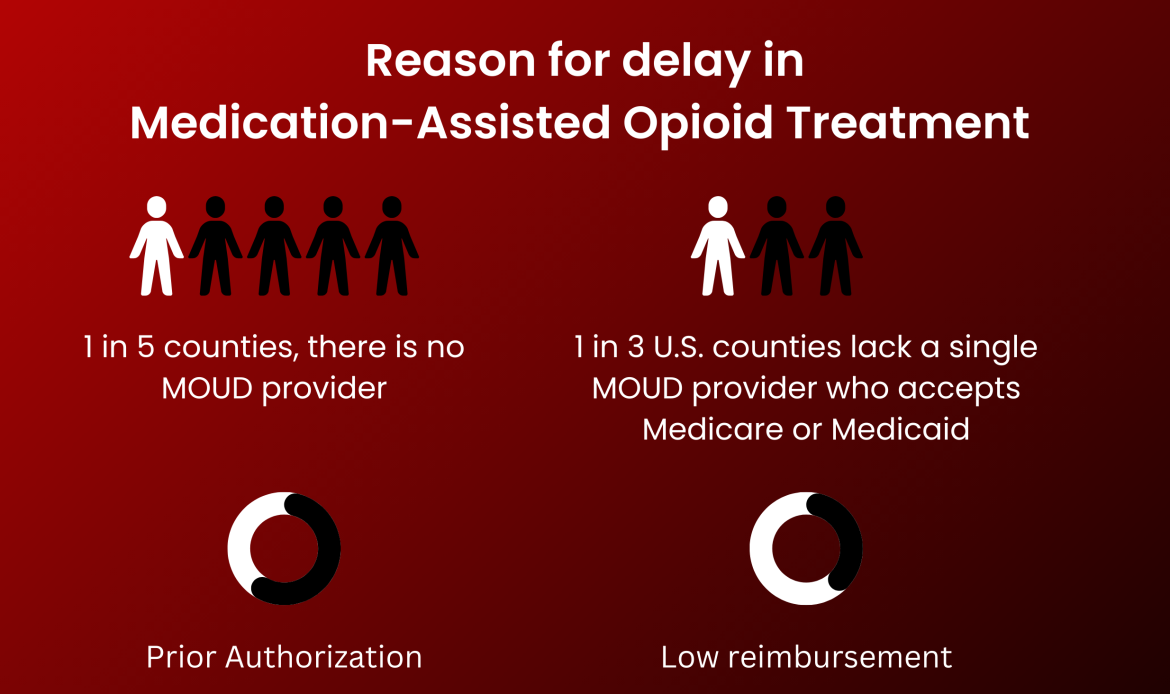
Imagine needing help, but finding that there’s nowhere to go. Sadly, that’s the reality for many people seeking medication-assisted opiod treatment (OUD). According to the OIG report, nearly 1 in 3 counties across the U.S. does not have a single provider for MOUD treatment that accepts Medicare or Medicaid. What does this mean for you? If you rely on Medicare or Medicaid for your healthcare, the chances of finding a local Medication-assisted opioid treatment provider might be slim, and even if you do, there’s no guarantee they can see you quickly.
In 1 in 5 U.S. counties, there isn’t a single MOUD provider at all. In areas labeled as “high-need” for OUD treatment, more than 100 counties have no medication provider available. This means that patients like you, who are at critical points in your recovery, are struggling to get help simply because there aren’t enough professionals around to prescribe the medications that can make all the difference.
Office-Based Buprenorphine Providers: A Mixed Picture
- Only 1 in 4 office-based buprenorphine providers accept Medicare.
- These providers are slightly more likely to treat Medicaid enrollees than Medicare patients, but the overall access is still limited.
The Roadblock of Prior Authorization: Time You Don’t Have
As if the shortage of providers isn’t enough, prior authorization — the requirement for your healthcare provider to get approval from your insurance company before certain treatments or medications — creates another barrier to timely care. If you’ve ever had to wait for your medication to be approved, you know how frustrating this process can be. It’s especially tough when you’re dealing with something as serious as opioid use disorder.
For Medicare Advantage plans, prior authorization is a major hurdle. Many providers who would otherwise treat Medicare patients are opting not to, simply because they don’t want to deal with the administrative burden of getting authorization. This isn’t just about paperwork; it’s about critical delays in your care.
The Centers for Medicare & Medicaid Services (CMS) officials acknowledged that prior authorization is the most common reason MOUD providers hesitate to treat Medicare patients. Every day you’re forced to wait for approval is a day your recovery is put on hold. And we all know that time is of the essence when it comes to opioid use disorder treatment.
Low Reimbursement Rates: Why Some Providers Don’t Treat Medicaid Patients
In addition to the issues of prior authorization, another factor that limits your access to treatment is low reimbursement rates for Medicaid enrollees. Many providers are hesitant to treat patients who rely on Medicaid because they feel the reimbursement rates are too low to justify the cost of providing care.
This means that even if a provider could help you, they may choose not to, simply because they wouldn’t be fairly compensated for their services. It’s a harsh reality, but it’s something that’s affecting access to care across the country.
Conclusively,
- 1 in 3 U.S. counties lack a single MOUD provider who accepts Medicare or Medicaid . In 1 in 5 counties, there is no MOUD provider ( office of inspector general )
- 62% of providers cite administrative burden from prior authorization as a major reason for delaying or declining treatment ( American Medical Association )
- 41% of providers state that low reimbursement rates for Medicaid patients discourage them from offering MOUD ( American Society of Addiction Medicine )
What Can Be Done to Help?
With all of these challenges, it’s easy to feel like the system is working against you. But there are ways to improve access to Medication-assisted opioid treatment for opioid use disorder.
- Targeting high-need areas to increase the number of MOUD providers who treat Medicare and Medicaid enrollees.
- Working with states to assess and potentially increase Medicaid reimbursement rates for MOUD treatment.
- Developing and maintaining a list of active office-based buprenorphine providers, so patients like you can find the help you need more easily.
But what can be done in the meantime to speed up the process for patients like you?




Streamlined Prior Authorization and Insurance Verification
- Automation and AI: We use advanced technologies to streamline the prior authorization process, reducing the wait time for approval. Instead of your provider being bogged down with paperwork, we handle the heavy lifting, so you get your medication sooner.
- Insurance verification: We also assist healthcare providers in verifying your insurance information quickly and efficiently. This means that when you show up for treatment, there’s less waiting around to ensure that your insurance covers your care.
More Providers, More Access
By helping to make the administrative side of healthcare more efficient, we’re also helping more providers participate in programs like Medicare and Medicaid. When prior authorization becomes less of a burden, more providers will be willing to treat patients like you.
At the end of the day, faster approvals mean faster access to the life-saving treatments you need.
Your Journey to Recovery Deserves Support
If you’re facing delays or barriers to accessing medication-assisted treatment, know that you’re not alone. The system is far from perfect, but there are steps being taken to improve it. From increasing the number of providers in high-need areas to streamlining the prior authorization process, efforts are underway to help make your path to recovery smoother.
In the meantime, leveraging technology like AI and automation can help providers move faster, get the approvals they need, and get you the care you deserve without unnecessary delays. Your health matters, and with the right support, you can overcome the obstacles that stand between you and your recovery.
Opioid use disorder treatment is already challenging enough — don’t let red tape make it harder. Reach out to your healthcare provider and explore how technology can help you get the care you need, when you need it.