
Table of Contents
This group therapy practice was discovered three months after it had started. A block of patients had lost coverage at the time of the year transition. No one checked. 72 sessions were delivered, and all 72 were denied. Recovered in 4 months; less than half of them.
This is not atypical. Manual eligibility verification for Behavioral Health is one of the most reliable, preventable revenue drains in the specialty. The staff calls payers. They wait on hold. They record information that is valid today, incorrect in two weeks, and only re-verified when a denial arrives. Automation does more than resolve this. It alters the risk profile of the entire front end of the practice.
What Is Insurance Eligibility Verification in Behavioral Health?
It is the process of verifying a patient’s current insurance coverage, benefits, costs, and network status before service is rendered. A benefits verification goes a step further and verifies behavioral health-specific benefits such as session limits, deductibles, copay amounts, and prior authorization needs.
The two terms are often used interchangeably. However, they are not identical. You can have an eligible patient (coverage is active), and their claim denied because their behavioral health benefits were verified incorrectly under the wrong benefit structure.
Eligibility Errors Are Costing You Before Care Even Starts
Every manual verification is a hold time, a data entry risk, and a revenue exposure. BehavioralProz helps behavioral health practices build automated eligibility workflows that protect revenue from the front door forward.
Why Is Eligibility Verification More Complicated in Behavioral Health?
Most eligibility responses from clearinghouses will confirm that there is coverage under the medical benefit plan, but this is insufficient. BH providers need to verify a specific set of details, and failures here lead to errors:
Behavioral health carve-outs: The majority of commercial carriers have carve-outs of their mental and SUD benefits, and this coverage will rest under another Managed Behavioral Healthcare Organization or MBHO (e.g., Optum Behavioral Health, Carelon, Magellan). When verification is completed at the primary payer, it simply confirms the core plan is active. It will not confirm that the BH benefit is active and the provider is enrolled with the MBHO, which leads to CO-4 denials on every claim.
Session limits and benefit structure: Many BH plans have distinct benefits for the specialty, including separate limits and distinct deductibles/copays. Many times the medical plan deductible is applied to the therapy services, which leads to incorrect patient costs and claims being denied later.
ABA coverage: There are often specific benefits related to ABA services, including separate authorization requirements and rules related to how the service is delivered and billed for. These rules are often dictated by state laws and mandates for autism coverage.
Telehealth coverage variations: Since the pandemic, many payers have varied requirements regarding the modalities they will cover for telehealth as well as platform requirements. An assumption that telehealth is covered is insufficient; many providers are billed for audio only, which is not a covered service under the insurance plan.
Medicaid MCO changes: Since Medicaid enrollment is subject to monthly shifts when patient’s insurance changes plans, these need to be consistently re-verified. Even when using a practice management system, claim submissions must be accurate and up-to-date to avoid a denial.
What Problems Are Mental Health Practices Experiencing With Manual Verification?
| Challenge | Operational Impact | Revenue Impact | Denial Risk |
|---|---|---|---|
| Hold times of 15 to 45 minutes per call | Staff unable to complete same-day verification | Delays scheduling or gaps in coverage confirmation | High |
| Human data entry errors | Wrong copay, wrong deductible, wrong benefit info recorded | Patient underpayment or billing dispute | Moderate |
| No re-verification before follow-up visits | Coverage lapse undetected for weeks | Multiple sessions denied retroactively | High |
| MBHO carve-out not identified | Claims routed to wrong payer | CO-4 denial on every affected claim | Very High |
| Authorization assumed from eligibility confirmation | Services delivered without authorization | Entire episode retroactively denied | Very High |
| MCO changes between Medicaid visits | Claim routed to previous MCO | CO-B7 or CO-4 across multiple sessions | High |
How Does Automated Eligibility Verification Work?
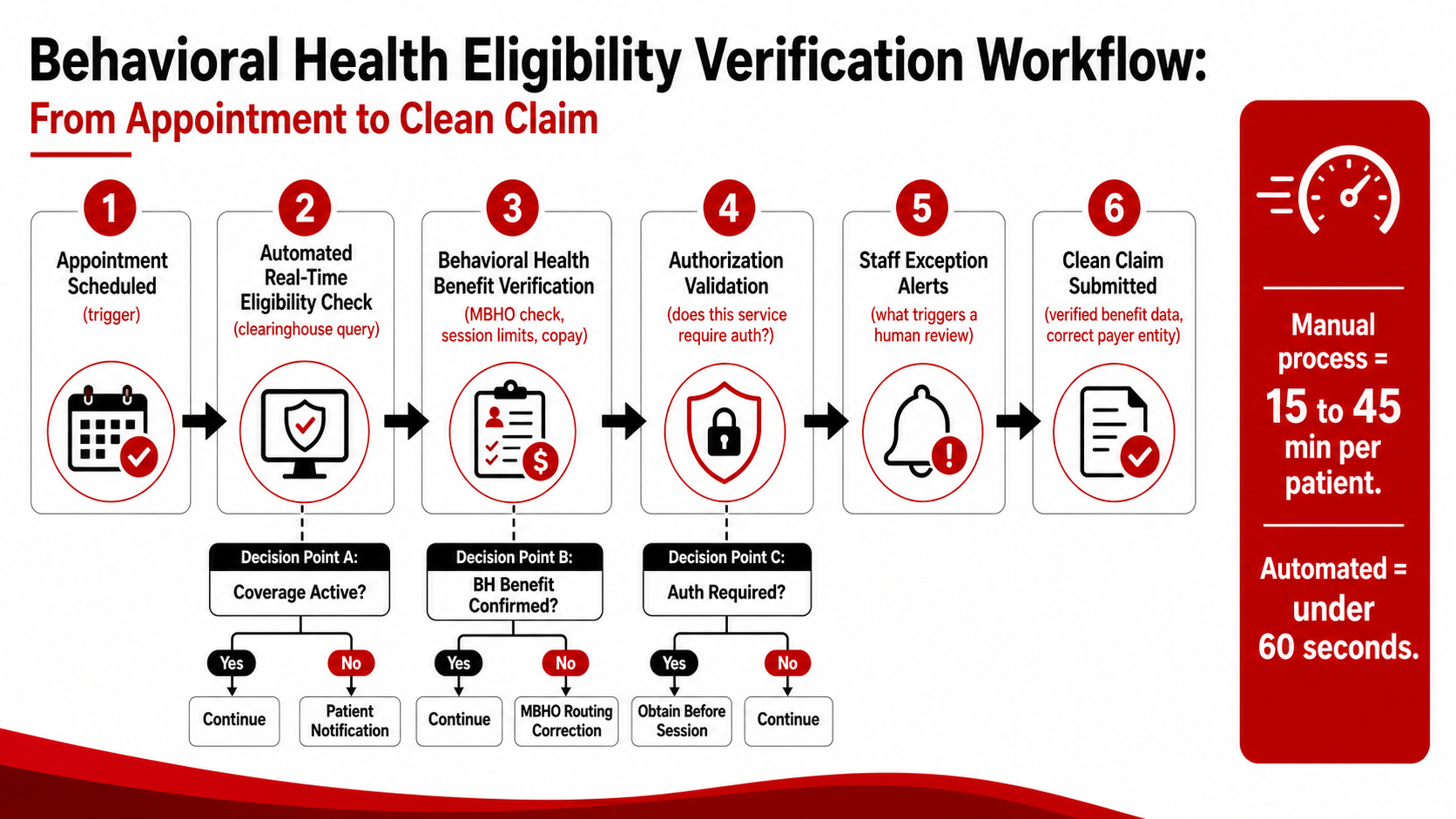
Automation does not remove the human from the process. It removes the human from the parts of the process that do not require judgment, so they can focus on the parts that do: resolving exceptions, contacting patients about coverage changes, and managing authorization follow-up.
Your Clearinghouse Can Do More Than You Think
Most behavioral health practices use less than 30% of their clearinghouse’s eligibility capability. BehavioralProz configures and optimizes eligibility automation for your specific payer mix and facility type.
What Are the Biggest Benefits of Automating Eligibility Verification?
How Does Automation Reduce Claim Denials?
Eligibility-related denials inactive coverage, wrong payer, and carve-out routing errors are eliminated when verification runs automatically before every scheduled appointment. Clean claims from verified benefit data submit the first time correctly.
Revenue impact: Practices that implement real-time eligibility automation typically see eligibility-related denial rates drop from 8 to 12% of claims to under 2%.
How Can Eligibility Automation Improve Cash Flow?
Having the appropriate cost share information collected upfront at the time of service results in an earlier cash influx to the practice. Instead of waiting for a denied claim, an appeal, and a second payment request, the money comes directly in with each billing cycle and reduces AR.
Why Does Automation Reduce Front Desk Workload?
A person managing to verify 20 clients each day on average spends 2 to 4 hours per day on hold with various insurance companies. With automation, it takes seconds for eligibility to be verified, which allows more time to perform patient-facing duties such as scheduling, intakes, and addressing the needs of patients.
How Does Automation Improve Patient Experience?
Patients receive accurate cost-sharing information before their appointment. Copays and deductible amounts are confirmed, not estimated. Surprise bills from unexpected coverage lapses are prevented. Patient satisfaction and collection rates both improve.
Why Does Eligibility Automation Matter for ABA Providers?
ABA practices often manage 30 to 100 active patients, each requiring verification across multiple Medicaid MCOs, commercial plans with ABA-specific benefits, and separate BCBA authorization requirements. Manual verification at that volume is not sustainable. Automation is not optional for ABA providers scaling beyond a handful of clinicians.
How Can Multi-Location Behavioral Health Practices Benefit?
Multi-location organizations face inconsistent verification practices across sites. Automation standardizes the process, creates centralized reporting on eligibility-related denials, and gives leadership visibility into which locations are generating the most eligibility errors.
Free: Behavioral Health Operations Playbook
Eligibility verification, denial prevention, RCM KPIs, and operational benchmarks in one guide.
What Should Behavioral Health Practices Verify Before Every Visit?
- [ ] Coverage at the date of service (not date of verification call)
- [ ] BH benefit (not just the Medical Benefit)
- [ ] Carve-out and routing
- [ ] Cost share details (copay/coinsurance and deductible amounts)
- [ ] Provider and facility participation on the plan
- [ ] Session limits and benefit period
- [ ] Telehealth verification of audio/video requirements
- [ ] Authorization requirements
- [ ] Referral requirements if applicable for a plan
- [ ] Secondary insurance COB
What Technology Stack Supports Eligibility Verification Automation?
| Tool Type | Role | Examples |
|---|---|---|
| EHR/Practice Management | Triggers verification at scheduling; stores benefit data | SimplePractice, TherapyNotes, AdvancedMD, Kareo |
| Clearinghouse | Processes real-time eligibility queries to payers | Availity, Waystar, Change Healthcare |
| RCM Platform | Parses eligibility responses; flags exceptions; triggers alerts | Various; often integrated with clearinghouse |
| Authorization Tracker | Monitors auth status, expiration, and renewal requirements | Standalone or EHR module |
| Real-Time Eligibility API | Direct payer connection for immediate benefit data | Payer portals with API access |
Which KPIs Should Practices Track After Automating Eligibility Verification?
| KPI | Target Benchmark | Warning Sign |
|---|---|---|
| Eligibility-related denial rate | Under 2% | Above 5% indicates verification gaps |
| Clean claim rate | 95% or higher | Below 90%: eligibility or coding issues |
| First-pass acceptance rate | 90% or higher | Below 85%: submission or verification errors |
| Patient collection rate at visit | 85% or higher | Below 70%: copay not confirmed before visit |
| Verification turnaround time | Under 60 seconds (automated) | Over 24 hours: manual process still in place |
| Staff hours on eligibility per day | Under 30 minutes (automated) | Over 2 hours: automation not deployed or exceptions too high |
What Mistakes Should Practices Avoid When Automating Eligibility Verification?
- Assuming active eligibility means authorization is not required
- Verifying only the base plan, not the MBHO carve-out
- Running eligibility at scheduling and not re-verifying 24 to 48 hours before the visit
- Not building MBHO identification into the verification workflow
- Treating automation as a set-and-forget system without monitoring exceptions
- Ignoring Medicaid MCO changes for returning patients
- Failing to verify ABA benefits separately from general behavioral health benefits
What Should Behavioral Health Leaders Do Next?
- [ ] Audit the last 90 days of eligibility-related denials by denial code and payer
- [ ] Confirm whether your EHR triggers automated eligibility checks at scheduling
- [ ] Verify that your clearinghouse returns behavioral health-specific benefit detail, not just active/inactive
- [ ] Add MBHO carve-out identification to your standard verification checklist
- [ ] Set up re-verification 24 to 48 hours before every appointment
- [ ] Train front desk staff on what to do when exceptions are flagged
- [ ] Add an eligibility-related denial rate KPI to your weekly billing review
Key Takeaways
Eligibility Verification Automation for Behavioral Health
Stop Discovering Eligibility Problems After the Session
Real-time automated verification catches coverage gaps, carve-out routing issues, and authorization requirements before a single claim is submitted. BehavioralProz builds the workflow.
Frequently Asked Questions
What is insurance eligibility verification in behavioral health?
It is the process of confirming a patient’s active coverage, behavioral health benefits, cost-sharing, session limits, and authorization requirements before services are delivered. It differs from simple coverage confirmation because behavioral health benefits are often managed separately by carve-out payers.
How frequently should behavioral health practices verify eligibility?
Behavioral health practices should verify patient eligibility at least at the time of scheduling and again 24-48 hours before the appointment. For all Medicaid patients, it is crucial that a practice re-verify patient eligibility prior to every single visit, since it can change monthly.
Does eligibility verification stop denials?
Yes, there are many denials related to patient eligibility (active coverage, incorrect payer routings, car-out errors) that are largely avoidable and should be stopped through eligibility verification before a claim is ever generated.
What is the difference between eligibility verification and prior authorization?
Eligibility is verification of active coverage, benefits, out-of-pocket costs, visits, etc. Prior Authorization is a separate payer approval obtained before delivery of specific services. If a patient has eligibility benefits, they could still need prior authorization, and failure to do so results in a CO-15 denial.
Can eligibility verification be automated for behavioral health?
Yes. You can integrate real-time eligibility APIs through a clearinghouse, directly into your EHR/practice management system that verify coverage in seconds and flag an issue before the appointment.
Why do behavioral health practices struggle more with eligibility verification than other specialties?
Behavioral health plans have their benefits frequently “carved-out” to another managed behavioral health organization, or MBHO, that manages the benefits (e.g., Optum Behavioral Health, Carelon, Magellan). Independent eligibility verification is needed, plus credentialing and claims routing to the appropriate entity; general eligibility verification doesn’t alert you to the need to verify the carve-out.