

Table of Contents
Practice submitting 800 claims/month for the same number of collections? They are not a “payer” practice. They are a “visibility” practice.
The billing company is hard at work. Claims are moving in and out. Reports are in. There’s not a question being asked about why money isn’t being collected, or why, at a fundamental level, financial performance isn’t being measured.
And you and your business managers aren’t any clearer on those issues because not one single person has taught you what metrics to use besides billing metrics. This is the fundamental disconnect.
Here is where your attention should be focused.
Know Exactly Where Your Revenue Cycle Stands.
BehavioralProz provides behavioral health practices with a free billing performance review covering net collection rate, denial trends, AR aging, and payer-level analysis. You will leave knowing exactly what is working and what is not.
How Can You Tell Whether Your Behavioral Health Billing Company Is Actually Performing?
Billing company performance is measured by financial outcomes, not operational activity. The quantity of claims tells you that the company is active in submitting claims. It is the Net Collection Rate, Denial Rate, Percent 90-Day AR, and the Underpayment Collection Rate that show you what that work actually results in, as revenue.
A billing company that sends you Activity Reports and no Results Reports is informing you about its activities, not about your overall financial health.
8 Behavioral Health Billing Metrics Actually Matter
Claim volume tells you a billing company is active. It doesn’t tell you if they’re collecting your money. These 8 metrics separate a billing partner that’s actually performing from one that’s just staying busy. These are the metrics that reveal revenue cycle performance:
- Clean Claim Rate
- First-Pass Acceptance Rate
- Denial Rate
- Net Collection Rate
- Days in AR
- 90-Day AR Percentage
- Appeal Success Rate
- Underpayment Recovery Rate
#1. Clean Claim Rate
The percentage of claims accepted by the payer on first submission without correction. Target: 95% or higher. Below 90% means systematic submission errors.
#2. First-Pass Acceptance Rate
Similar to clean claim rate but measured at the clearinghouse level. Tells you whether claims are structurally correct before they reach the payer.
#3. Denial Rate
The percentage of submitted claims denied by the payer. For behavioral health, 5% to 8% is acceptable; above 10% is a systemic problem. The useful version of this metric is denial rate by payer and denial rate by CPT code, not aggregate only.
#4. Net Collection Rate
The percentage of collectible revenue actually collected after adjustments. Target: 95% or higher. This is the single most important revenue performance metric. A billing company that reports gross collections without net collections is hiding write-offs.
RELATED READING

In-House vs. Outsourced Mental Health Billing: Which Is Actually Better for Your Practice?

What to Do When eClinicalWorks Support Can’t Solve Your Billing Configuration Problem?

The Real Cost of Outsourcing Behavioral Health Billing in 2026
#5. Days in AR
How long it takes from service to payment. Target: under 35 days. Above 50 days consistently indicates submission delays, payer follow-up failures, or denial backlogs.
#6. 90-Day AR Percentage
Claims outstanding over 90 days as a percentage of total AR. Target: under 10%. Above 15% is a significant warning sign that denials are not being worked.
#7. Appeal Success Rate
The percentage of denied claims overturned through appeal. Target: 60% or higher. A low appeal success rate combined with a high denial rate is very expensive.
#8. Underpayment Recovery Rate
The percentage of underpaid claims where the shortfall was identified and pursued. Many billing companies post what payers send without verifying it against contracted rates.
If You Can't Answer These Questions, Your Billing Company Can't Either.
BehavioralProz offers full-service behavioral health billing with monthly KPI reporting, payer-level denial analysis, and AR management built for practices that expect financial accountability from their revenue cycle partner.
What Should a Behavioral Health Billing Dashboard Actually Show?
| Metric | What It Measures | Warning Sign |
|---|---|---|
| Net collection rate | Revenue actually collected vs. collectible | Below 92% |
| Denial rate | Claims refused by payer | Above 10% |
| Clean claim rate | First-submission accuracy | Below 90% |
| Days in AR | Speed from service to payment | Above 50 days |
| 90-day AR % | Unresolved claim backlog | Above 15% of total AR |
| Appeal success rate | Effectiveness of denial recovery | Below 50% |
| Charge lag | Days from service to claim submission | Above 3 days consistently |
| Underpayment flags | Payers paying below contracted rate | Any consistent pattern |
Which Metrics Can Make a Billing Company Look Good While Revenue Still Suffers?
This is the section most billing articles miss. These are the metrics that look fine on a report while the practice loses money:
High claim volume: Filing more claims is activity, not performance. You can submit all your claims on day one and still have 20% of your claims denied with no follow-up.
Fast submission speed: Submitted claims within 24hours; “it’s a good operating metric; it isn’t a real financial performance metric.”
Low apparent denial rate due to delayed reporting: Some billing companies report denials when they are worked, not when they are received. This makes the denial rate look lower than it is.
High gross collection rate without net context: A practice collecting 85% of billed charges looks fine until you discover 12% was written off rather than appealed.
“All claims worked” without outcome data: Claims can be worked and closed as uncollectible. Without tracking how much was actually recovered per dollar worked, the activity metric tells you nothing about recovery performance.
What Behavioral Health Problems Can Distort These KPIs?
Behavioral health billing has specific complexity that inflates denial rates and depresses collections when not managed correctly:
- MBHO carve-out routing errors: Claims submitted to the base commercial payer instead of Optum BH, Carelon, or Magellan generate CO-4 denials at scale
- Prior authorization lapses: IOP, PHP, ABA, and residential programs require concurrent review; expired auths generate retroactive denials that inflate 90-day AR
- Time-based CPT code mismatches: Documentation does not match the time bracket billed; CO-11 medical necessity denials follow
- Telehealth modifier and POS errors: GT vs 95, POS 10 vs 11 wrong combination for the payer generates systematic denials
- Credentialing gaps: New providers billed before NPI is enrolled with the payer; CO-B7 denials on all claims from that provider
- Modifier errors in psychiatry: Modifier 25 missing on E/M plus add-on claims; CO-97 bundling denials reduce payment on legitimate combined visits
A billing company without behavioral health specialization will not proactively monitor or prevent any of these; they will surface only after the denial has aged.
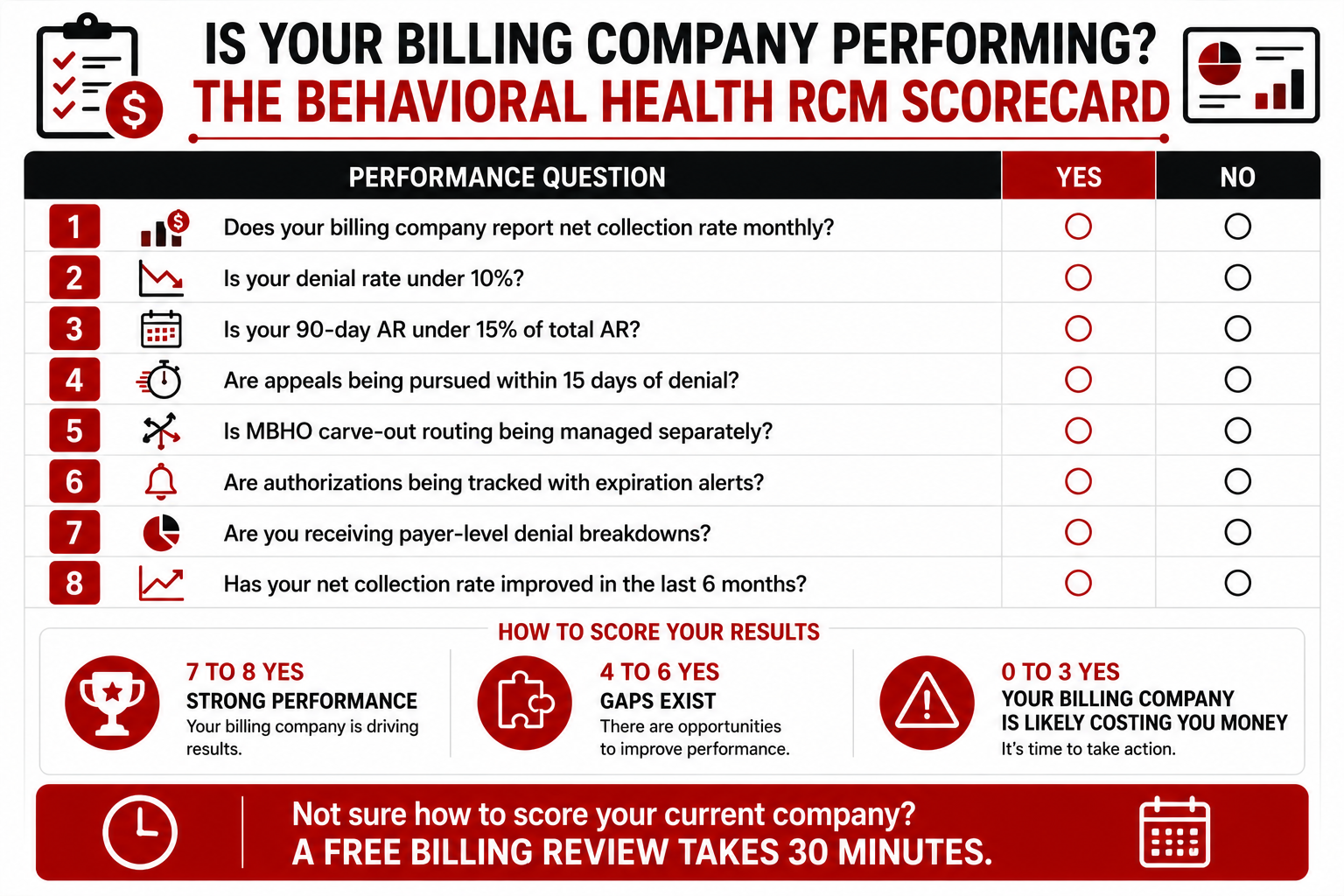
What Should You Ask Your Billing Company Every Month?
These questions convert a passive status report into an accountability conversation:
- What is our net collection rate this month, and how does it compare to last month?
- What are the top five denial reason codes this month, and what was done about each?
- How much AR is over 90 days, and which payers are responsible for the largest portion?
- How many claims were appealed, and what was the recovery rate?
- Which payers are paying below our contracted rates, and what is being done about underpayments?
- What is our charge lag this month (days from service to claim submission)?
- How many credentialing or enrollment issues are currently blocking claims?
- How much revenue was recovered from aged AR this month?
If your billing company cannot answer all eight in the same meeting, that is an answer.
When Should You Consider Replacing Your Behavioral Health Billing Company?
How Can a Practice Benchmark Its Billing Performance Before Making a Change?
Before evaluating a new vendor, run a 90-day performance audit on your current one:
- Pull your net collection rate by month for the last 12 months. Is it trending up or down?
- Pull your denial rate by payer. Which payers are consistently above 10%?
- Pull your 90-day AR as a percentage of total AR. Is it growing?
- Pull your write-off rate. Are claims being written off at rates that suggest they were never appealed?
- Pull your charge lag. Are claims being submitted within 3 days of service consistently?
These five data points tell you whether the billing company is improving your financial position or simply maintaining it.
Compare Your Current Billing Performance.
Pull your net collection rate, denial rate, and 90-day AR percentage for the last three months. Then let us show you what those same numbers look like at practices we manage.
Frequently Asked Questions
What are the most important behavioral health billing KPIs?
Net collection rate, denial rate by payer, days in AR, percentage of AR over 90 days, and appeal success rate. All five will tell you whether the billing company can collect on your receivables or is merely submitting claims.
What is a good clean claim rate for behavioral health?
95%. Any reading below 90% Indicates an underlying systemic error, often not corrected on a claim-by-claim basis; often requires further analysis to the source.
What does net collection rate tell a behavioral health practice?
Net collection rate is the measure that reflects the percentage of dollars deemed collectible by the company that was collected. This is the purest indicator of the billing company’s financial success and the metric most likely to be absent on most billing company statements.
What does high 90-day AR mean for a behavioral health practice?
Means denied or paid claims are not being worked fast enough. Any aging accounts over 90 days have missed or are nearing timely filing, and those may soon become past recovery.
How often should a billing company report KPIs to a behavioral health practice?
Monthly minimum, with key metrics to include denial rate, net collections, and 90-day A/R to be reviewed every week. Monthly payer-level view and monthly provider-level view.
What is the difference between denial rate and clean claim rate?
Your clean claim rate refers to how many of your claims submitted will be accepted by the clearinghouse and payer on their first entry. While the claim denial rate shows how many are adjudicated and not paid by the Clearinghouse or Payer. A company can also have a high clean claim rate and still suffer from a high claim denial rate based upon medical necessity, prior authorization, or coding.