

Table of Contents
Outsourced behavioral health credentialing typically costs $150 to $500 per provider for initial payer enrollment under a flat-fee model, or 1 to 3% of collected revenue under a percentage-based arrangement. Per-payer enrollment fees range from $25 to $75 per payer per provider. Ongoing re-credentialing and maintenance run $50 to $150 per provider per year.
That is the number. What follows explains what affects it and what you should expect to be included.
What Does Behavioral Health Credentialing Cost in 2026?
| Service | Typical Cost Range |
|---|---|
| Initial payer enrollment (flat fee, per provider) | $150 to $500 per provider |
| Initial payer enrollment (percentage-based) | 1 to 3% of collections for the credentialing scope |
| Per-payer enrollment fee (add-on model) | $25 to $75 per payer per provider |
| CAQH profile setup or update | $50 to $150 one-time, or included in full-service |
| Re-credentialing (every 2 to 3 years) | $75 to $200 per provider |
| Ongoing maintenance (CAQH re-attestation, tracking) | $50 to $150 per provider per year |
| Credentialing bundled with full RCM billing services | Often included in billing percentage — confirm scope |
Price alone is not a reliable metric for comparison. A vendor charging $150 per provider who misses MBHO carve-out enrollment, causing CO-B7 denials for every claim from the unenrolled payer, costs far more than a $400 vendor who gets it right the first time.
Tired of the credentialing guesswork?
Stop wondering what it costs or how long it takes. In just one short call, we’ll map out your exact timeline, target payers, and transparent pricing with zero commitment required.
What Drives Credentialing Costs Up or Down?
These factors move your actual quote in either direction:
- Number of providers: Most vendors price per provider; a 15-provider group costs less per provider than a solo practice at many firms
- Number of payers: More payers per provider means more applications, more follow-up, and more tracking costs
- Specialty type: ABA credentialing involves separate ABA-specific payer departments and BCBA verification; psychiatry adds DEA and e-prescribing enrollment, both of which carry higher complexity
- MBHO carve-out enrollment: Credentialing with Optum Behavioral Health, Carelon, and Magellan separately from the base commercial plan is additional work; confirm it is included, not extra
- Existing CAQH profile status: A complete, current CAQH profile accelerates every payer application; a missing or lapsed profile adds setup time and cost
- Timeline urgency: Expedited credentialing (when a provider needs to bill in under 60 days) may carry a premium
- Multi-state Medicaid enrollment: Each state program and Medicaid MCO requires independent enrollment; multi-state organizations pay more, appropriately
Flat-Fee vs. Percentage-Based Credentialing: Which Is Better?
| Factor | Flat-Fee Model | Percentage-Based Model |
|---|---|---|
| Cost predictability | High — fixed per provider | Lower — tied to collections |
| Best for | Practices with stable provider rosters | Practices bundling credentialing with full billing |
| Incentive alignment | Neutral — vendor paid at signing | Aligned — vendor earns when you collect |
| Risk if credentialing is slow | You pay regardless of the timeline | Vendor loses revenue if enrollment is delayed |
| Typical for | Standalone credentialing vendors | Full-service RCM billing companies |
| MBHO enrollment included? | Varies — ask specifically | Often included in full-service scope |
The flat-fee model works well for practices with a clear, fixed provider count. The percentage-based model makes more sense when credentialing is bundled into a full behavioral health billing and RCM services engagement because the billing company has a direct financial incentive to complete credentialing quickly and correctly.
RELATED READING

7 Credentialing Mistakes That Are Costing Behavioral Health Practices Months of Revenue
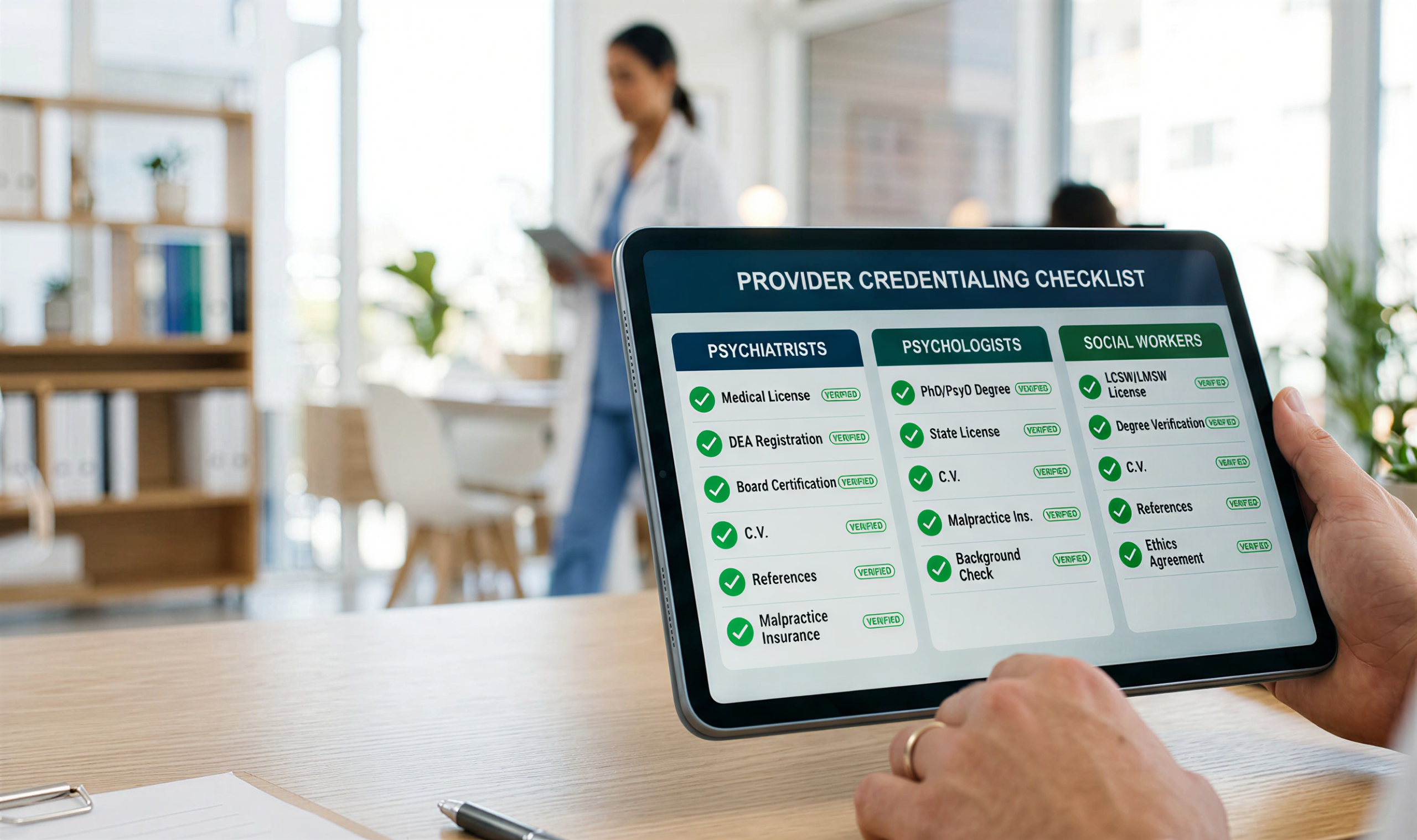
Behavioral Health Credentialing Requirements: The Complete Specialty-by-Specialty Checklist

The Real Cost of Outsourcing Behavioral Health Billing in 2026
What Is Included in BehavioralProz's Credentialing Service?
Not all credentialing vendors cover the same scope. Here is what BehavioralProz’s credentialing services include:
- Payer enrollment applications for all target commercial payers
- MBHO carve-out enrollment: Optum Behavioral Health, Carelon, Magellan submitted separately from base commercial plan applications
- Medicare PECOS enrollment for applicable providers
- Medicaid enrollment for state programs and MCOs as specified
- CAQH profile setup, completion, and 120-day re-attestation management
- Application status follow-up at Day 30, Day 60, and Day 90 with escalation to provider relations when applications stall
- Effective date tracking and notification: you are told in writing when you can start billing each payer
- Revalidation and recredentialing tracking, we flag upcoming deadlines 90 days in advance
- Denial-risk prevention credentialing gaps that would generate CO-B7 denials are identified before claims are ever submitted
Know your exact credentialing roadmap in 48 hours.
Stop leaving money on the table while waiting for payer approvals. Let’s build a custom strategy tailored to your specialties, provider count, and billing workflow to get you paid faster.
Frequently Asked Questions
How much does it cost to credential a behavioral health provider?
Under a flat-fee model, initial payer enrollment typically ranges from $150 to $500 per provider, depending on specialty complexity, the number of payers, and whether MBHO carve-out enrollment is included. Percentage-based credentialing, when bundled with full billing services, typically runs 1 to 3% of collected revenue for the credentialing component.
How long does behavioral health credentialing take?
Commercial payers typically take 60 to 90 days. MBHO carve-outs (Optum BH, Carelon, Magellan) take 90 to 120 days. Medicare PECOS runs 60 to 90 days. State Medicaid programs range from 90 to 180 days. Starting credentialing at hire, not at first patient, is the single most impactful thing a practice can do to reduce the revenue gap.
Do you charge per payer or per provider?
BehavioralProz prices credentialing per provider, with all target payers included in the scope, not per individual payer application. This avoids unexpected line-item charges as your payer panel grows. Confirm this structure with any vendor you are comparing.
What is included in a credentialing quote?
A complete credentialing quote should specify: which payers are included (base commercial plans AND MBHOs), whether CAQH setup and re-attestation are covered, whether Medicare and Medicaid enrollment are in scope, what the follow-up and escalation process looks like, and whether re-credentialing and maintenance are separate fees.
Can credentialing be bundled with billing services?
Yes. For practices outsourcing both billing and credentialing, bundling is usually more cost-effective and operationally cleaner. One team manages both the payer enrollment and the claim submission, which eliminates the coordination gap that creates CO-B7 denials.