

Table of Contents
Navigating Revenue Cycle Management in Autism Care is crucial for healthcare providers striving to enhance patient outcomes while maintaining financial sustainability. The growing demand for autism-related behavioral health services, coupled with intricate billing and coding requirements, highlights the need for streamlined processes and integrated care models. This blog explores strategies to overcome these challenges, highlighting expert insights into behavioral health billing and collaborative care practices.
What is Autism RCM (Revenue Cycle Management)?
Autism RCM refers to the complete financial and administrative process that autism and ABA therapy providers use to capture, manage, and collect reimbursement for services rendered.
It covers everything from insurance eligibility verification and prior authorization to ABA-specific CPT code billing, claims submission, denial management, and accounts receivable follow-up.
It applies to any provider delivering autism services: ABA therapy clinics, BCBAs, RBTs, multi-specialty behavioral health practices, and school-based or telehealth ABA providers.
Why it matters: ABA billing has a denial rate 5–10% higher than standard medical billing, and the most common causes- authorization gaps, documentation mismatches, and coding errors- are largely preventable with the right RCM system.
🔍 Struggling with ABA billing denials? Get a FREE Autism RCM Audit.
BehavioralProz specializes in revenue cycle management for autism and ABA providers. We’ll identify your top revenue leaks at no cost.
Key Challenges in RCM for Autism Care
1. Complex Behavioral Health Billing
Autism care often involves multiple services, from Applied Behavior Analysis (ABA) therapy to speech and occupational therapy. Managing billing for these services is challenging due to:
- The need to document services meticulously for reimbursement.
- Variability in payer requirements for codes like CPT 97151 and 97155 for ABA therapy.
- Denials related to incomplete or inaccurate submissions, which contribute significantly to Claim Denials in Autism Therapy.
2. Coding Errors and Reimbursement Delays
Accurate coding is critical for successful claims processing. Statistics reveal that coding errors contribute to 30-40% of claim denials in behavioral health. According to a report by BehaveHealth, the denial rate for behavioral health claims is 5-10% higher than for medical/surgical claims, underscoring the importance of precise coding. Common issues include using outdated CPT codes or improper documentation of services rendered, further complicating RCM Challenges in Autism Services.
3. Financial Strain Due to High Denial Rates
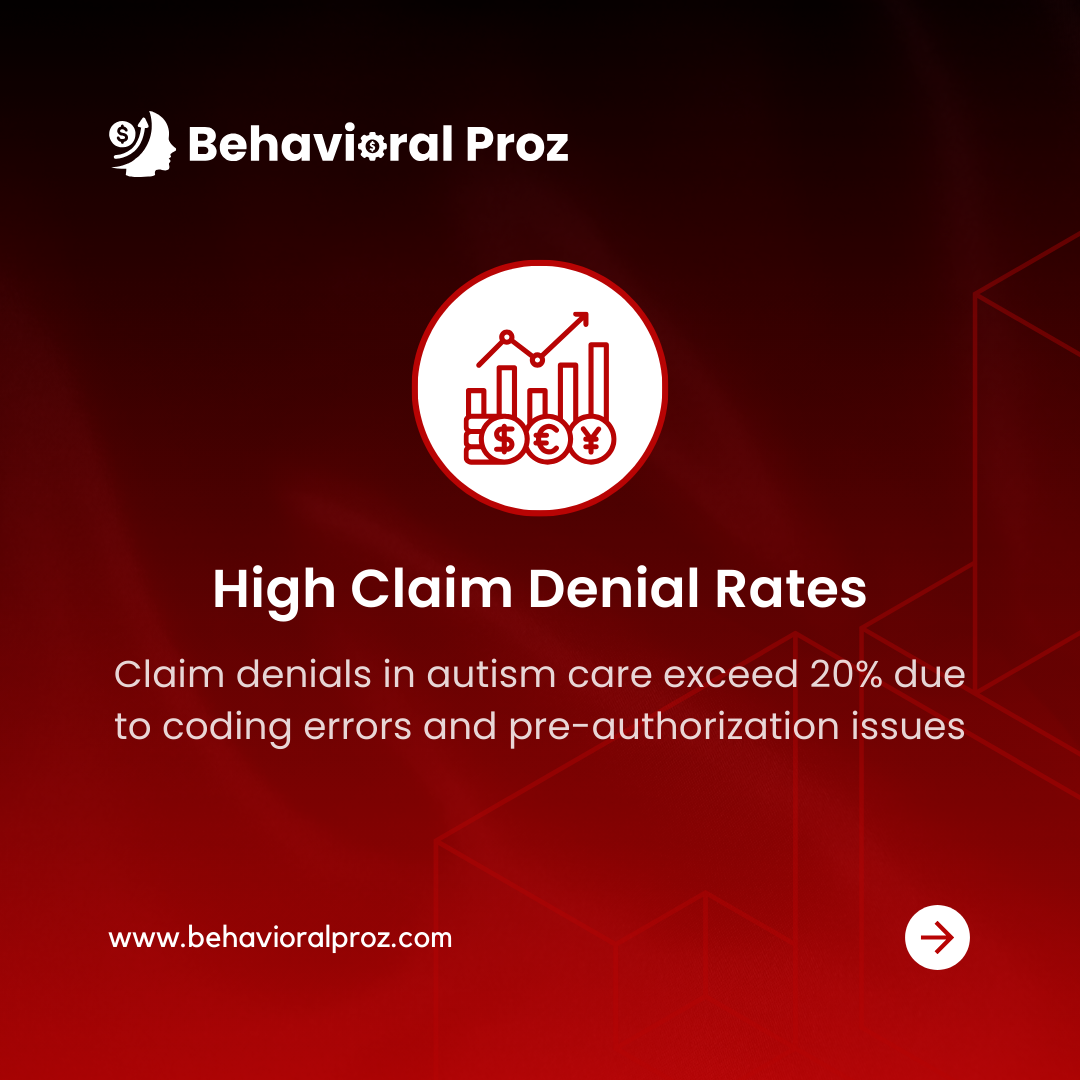
Healthcare organizations face financial strain due to high claim denial rates. In autism care, claims denial rates can exceed 20%, significantly impacting revenue streams. Root causes include a lack of pre-authorization and inconsistent payer policies, which are common causes of Claim Denials in Autism Therapy.
4. Workforce Shortages and Collaboration Gaps
The demand for autism care far outpaces the availability of trained behavioral health professionals. According to a 2022 report, the United States faces a shortage of 113,930 addiction counselors and 87,840 mental health counselors by 2037. These gaps hinder the ability to implement collaborative care models effectively, adding to RCM Challenges in Autism Services.
ABA CPT Codes: What Providers Get Wrong
The ABA CPT code family (97151–97158) is the backbone of autism billing. Here’s where each code trips providers up and what to watch for:
| CPT Code | Service Type | Common Denial Risk |
|---|---|---|
| 97151 | Behavior identification assessment | Missing initial BCBA signature or incomplete assessment docs |
| 97152 | Behavior identification-supporting assessment | Bundling errors with 97151; documentation mismatch |
| 97153 | Adaptive behavior treatment (direct) | Exceeding authorized units; session note gaps |
| 97154 | Group adaptive behavior treatment | Incorrect group size documentation; modifier errors |
| 97155 | Adaptive behavior treatment with protocol modification | Supervision level not documented; BCBA not on file |
| 97156 | Family adaptive behavior treatment guidance | Missing family attendance records; time documentation |
| 97157 | Multiple-family group guidance | Bundling issues; incorrect POS codes |
| 97158 | Group protocol modification | Underutilized; often underbilled or skipped entirely |
Strategies to Navigate RCM Challenges
1. Optimize Behavioral Health Billing Processes
- Implement custom electronic health record (EHR) systems integrated with billing modules to streamline documentation and claims submission.
- Train staff regularly on payer-specific billing guidelines to reduce errors and address Revenue Cycle Management in Autism Care proactively.
- Leverage tools like CPT code 99484 for collaborative care services, ensuring accurate billing for time spent on coordination.
2. Utilize Accurate and Up-to-Date Coding
- Stay informed about updates to CPT codes related to autism care, such as codes for ABA therapy.
- Use validated tools like the AMA’s CPT Professional Codebook for guidance on procedural codes.
- Engage in periodic audits to identify and rectify coding discrepancies, minimizing Claim Denials in Autism Therapy.
3. Establish Collaborative Care Models
Collaborative care models integrate behavioral health into primary care settings, ensuring holistic patient management. At Northwestern Medicine, integrating collaborative care has enabled providers to serve over 250,000 primary care patients efficiently. This model includes:
- Behavioral care managers coordinate care under primary care providers.
- Monthly billing processes for streamlined reimbursement.
- Using CPT codes like 99492 and 99493 for collaborative care management to support Revenue Cycle Management in Autism Care.
4. Address Workforce and Training Needs
- Partner with academic institutions to create a pipeline of trained professionals.
- Offer incentives like loan forgiveness to attract providers to underserved areas.
- Incorporate telehealth to bridge gaps in rural areas, where 69% of counties lack psychiatric mental health nurse practitioners (NPs).
Behavioral Health Integration: A Proven Solution
Models of Integration
- Co-Located Model: Behavioral health professionals work alongside primary care providers in the same location, facilitating smooth care coordination.
- Collaborative Care Model: A team-based approach that includes primary care providers, behavioral care managers, and consulting psychiatrists.
Benefits of Integration
- Enhances care quality by addressing both physical and behavioral health needs simultaneously.
- Reduces stigma associated with seeking behavioral health services.
- Improves patient engagement and outcomes, aligning with effective Revenue Cycle Management in Autism Care.
Effective Behavioral Health Billing and Coding
CPT Codes for Autism Care
- Utilize a wide range of Current Procedural Terminology (CPT) codes to support behavioral health integration.
- Examples include:
- Evaluation and Management (E&M) Codes: For initial assessments and follow-ups.
- 99406: Smoking cessation counseling, applicable to vaping cessation as well.
Overcoming Common Billing Challenges
- Automate billing workflows to reduce errors and streamline processes.
- Leverage electronic health records (EHRs) to track and manage claims efficiently.
- Train staff on the latest coding guidelines to ensure compliance and increase reimbursements.
Strategies for Small Practices
Simplified Billing Processes
- Collaborative care billing can be managed under the primary care provider’s name, eliminating the need for additional contracts.
- Focus on scalable models that can adapt to the practice’s size and patient volume.
Key Considerations
- Allocate resources efficiently, such as dedicating a portion of the psychiatrist’s time to collaborative care.
- Regularly review payer contracts to ensure compatibility with autism care services.
UtilizingTechnology for RCM Success
Electronic Health Records (EHRs)
- Centralize patient data to streamline billing and improve care coordination.
- Use analytics to identify trends and address recurring issues in claims processing.
AI Tools
Verify patient insurance eligibility in real time to minimize claim denials and expedite reimbursements.
Use scheduling AI to optimize appointment booking, reduce no-shows, and improve operational performance.
Leverage document AI to automate data extraction and streamline document management, ensuring accuracy and reducing administrative workloads.
Automation Tools
- Reduce administrative burdens by using RPA Solutions to automate repetitive tasks such as claim submissions and follow-ups.
- Ensure timely reimbursements by minimizing human errors, and supporting effective Revenue Cycle Management in Autism Care.


Enhancing Financial Sustainability
Optimizing Payer Contracts
- Negotiate contracts that align with the unique needs of autism care.
- Advocate for fair reimbursement rates for specialized behavioral health services.
Improving Patient Enrollment
- Educate patients and families about available services and coverage options.
- Simplify the enrollment process to ensure access to care without delays.
Role of Revenue Cycle Management Consultants
Behavioral Proz Revenue Cycle Management in Autism Care consultants play a pivotal role in overcoming RCM challenges in autism care. With their expertise, they:
- Assess existing workflows and identify areas for improvement.
- Implement tailored solutions to enhance billing accuracy and effectiveness.
- Provide training on the latest coding practices and payer requirements.
- Facilitate contract negotiations to secure optimal reimbursement rates.
- Ensure compliance with regulatory standards, reducing the risk of audits and penalties.
By partnering with RCM consultants, healthcare providers can focus on delivering high-quality autism care while maintaining financial health.
Before you leave, see how much revenue your autism practice might be losing.
The average ABA practice loses 8–15% of collectible revenue to preventable billing errors, authorization lapses, and unworked denials. Get a free revenue assessment, with no commitment, no pressure.
Conclusion
Navigating RCM Challenges in Autism Services requires a strategic approach that combines expert insights, strong billing practices, and advanced technology. Behavioral health integration models, streamlined workflows, and comprehensive staff training are key to achieving financial sustainability and improved patient outcomes.
Frequently Asked Questions
What are the biggest RCM challenges in autism care?
The most common RCM challenges in autism care are: (1) prior authorization failures — where approvals lapse or never get started before services begin; (2) documentation gaps — where session notes don’t precisely match billed units or treatment goals; (3) CPT coding errors — especially in the ABA-specific 97151–97158 code family; and (4) high denial rates, which exceed 20% for some autism providers and often go unworked past appeal deadlines.
Why is ABA billing so complex?
ABA billing is more complex than standard outpatient billing because it involves time-based units, multiple provider roles (BCBA, RBT, BCaBA) with specific supervision requirements, payer-specific prior authorization cycles that renew every 3–6 months, and a dedicated family of CPT codes where small errors, wrong modifiers, mismatched ICD-10, and exceeded authorized units trigger immediate denials. Each commercial payer can also define medical necessity differently, adding another layer of variability.
How can autism providers reduce claim denials?
The most effective strategies for reducing ABA claim denials are: verify eligibility on the actual service date (not just at intake); track authorizations with automated alerts set 30+ days before renewal; use EHR templates that match each payer’s documentation format; link every session note to treatment goals and billed units; and establish a weekly denial review process so rejected claims are appealed before payer deadlines. Practices that outsource to specialized autism RCM firms consistently report significant denial rate reductions.
What CPT codes are used for ABA therapy billing?
ABA therapy uses CPT codes 97151 through 97158. These include 97151 (behavior identification assessment), 97153 (adaptive behavior treatment by protocol, direct), 97155 (adaptive behavior treatment with protocol modification, BCBA), and 97156 (family adaptive behavior treatment guidance). Each code has specific rules around who can bill it, required supervision levels, and documentation. Using the wrong code or missing a required modifier is one of the top causes of ABA claim denials.
Should I outsource autism RCM or keep it in-house?
Most growing ABA practices benefit from outsourcing autism RCM — particularly if they’re experiencing denial rates above 10%, aging AR past 60 days, or staff spending significant time on billing instead of patient care. Specialized autism RCM firms understand payer-specific ABA billing rules, track authorization renewals proactively, and typically recover more in collections than their cost. In-house billing works well when your team is specifically trained in ABA CPT codes, and you have the capacity to manage denials actively.