

Table of Contents
Few behavioral health practices concentrate on getting paid. Less still concentrate on determining whether what the payer paid is really what they were supposed to pay. Payment posting is the practice of doing so.
If it’s done well, it’s the one process that will tell you every dollar that you’ve earned but didn’t receive, every underpayment the payer owes you, and whether the information on your financial statements really stands up.
Poorly or inaccurately done, on the other hand, leads to the chasm that begins where system values end and your bank balance begins. And it’s there that your revenue hemorrhages.
Your Payment Posting Process May Be Hiding Revenue Problems.
BehavioralProz provides a free Behavioral Health Billing Assessment that reviews your payment posting workflow, reconciliation accuracy, and AR performance before problems compound.
Difference Between ERA and EOB
| Factor | ERA (Electronic Remittance Advice) | EOB (Explanation of Benefits) |
|---|---|---|
| Format | Electronic file (835 transaction) | Paper or PDF document |
| Source | Payer to clearinghouse to billing system | Payer mailed or portal-accessible |
| Posting method | Auto-posted via clearinghouse (with review) | Manual entry required |
| Speed | Days after adjudication | 1 to 3 weeks after adjudication |
| Error risk | Low when mapped correctly; high if mapping rules are wrong | Higher — manual entry errors |
| Audit trail | Digital; easily reviewed | Paper-based; harder to track |
| Best practice | Use ERA with exception-based human review | Use only when ERA is unavailable |
The most common ERA posting mistake: Auto-posting turned on without human exception review. When ERA mapping rules are incorrect, payer code mismatches, or wrong adjustment reason codes, every claim posts incorrectly at scale. The errors are consistent, systematic, and rarely caught until a bank reconciliation fails or an audit surfaces the gap.
What Does a Complete Payment Posting Workflow Look Like?
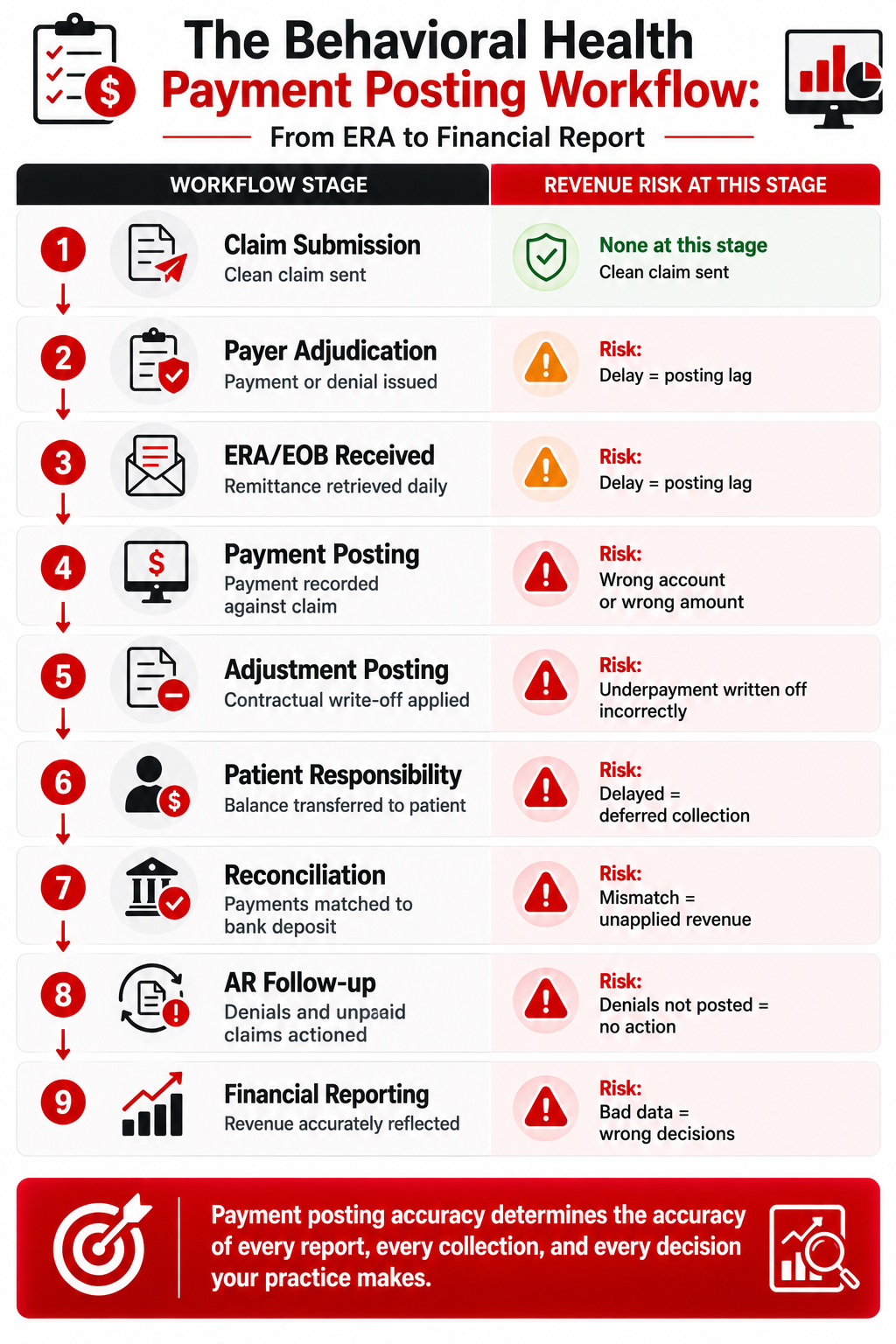
Most Common Payment Posting Mistakes in Behavioral Health
Payment posting errors in behavioral health can inflate aged receivables, create credit liabilities, and delay collections. Preventing these mistakes preserves revenue, reduces rework, and ensures accurate patient billing.
Post to incorrect claim or patient account
Accepting contractual adjustments without verifying the rate
Not posting denials at time of payment posting
ERA auto-posting without exception review
Unapplied payments creating artificial credit balances
Patient responsibility not transferred at posting
1. Post To Incorrect Claim Or Patient Account
The payment was allocated to the incorrect patient account or the wrong date of service and is still outstanding for an open claim. The old open claim is showing outstanding for aged AR with an extra balance on the wrong account, which a user overlooks. Of all the manual posting mistakes, this is probably the most frequent but also the most challenging to detect and correct if no reconciliation process is in place.
2. Accepting Contractual Adjustments Without Verifying The Rate
If a payer is covering $127 of a $175 claim. Then the differential amount of $48 should be checked with the contractual rate before applying the contractual adjustment and writing off the revenue. For example, if the contract rate is $155, it should adjust for underpayment, not write it off. Any practices that do not verify contract rates and apply the adjustments without checking do write off revenue, which will eventually be written back if it should be the underpayment.

3. Not Posting Denials At Time Of Payment Posting
When you receive an ERA with some payments and some denials, the denied claims must be posted denied at once; not kept in waiting. Non-posted denial claims never enter the denial management program. They will sit for a period, unresolved as paid/not paid, appeal/not appeal, until the claim ages for time limitation.
4. ERA Auto-Posting Without Exception Review
ERA auto-posting works well if rules are mapped correctly. If not, everyone posts with the same error in huge volumes. And while a practice that never reviews ERA files with exceptions at scale will miss underpayments, payments that are incorrectly applied, and patient balance transfers that are done wrong.
5. Unapplied Payments Creating Artificial Credit Balances
Cash receipts not identifiable to a specific claim typically sit in a suspense account or are posted as credits and, as such, are an ‘unapplied credit’. If unapplied credits are not identified within 30 days, they essentially turn into an accounts receivable liability, and the income they would equate to disappears in the aged report.
6. Patient Responsibility Not Transferred At Posting
Patient balance not reflected until collections after insurer EOB processing. The remaining balance that will be owed to you as coinsurance, co-payment, and deductible by the patient needs to be posted to the patient’s account upon the application of the payment and after the contract adjustment to the insured by your insurance company. Failure to do so makes the patient accounts deficient in balance, and collections are pushed back until this process is completed.
Are Your Payments Posted Correctly or Just Posted?
BehavioralProz audits payment posting workflows for behavioral health practices, identifying underpayments, misapplied adjustments, and reconciliation gaps that are quietly draining revenue.
How Does Poor Payment Posting Affect Behavioral Health Revenue?
Expert insight: “Many practices believe payment posting ends when payments are entered into the system. In reality, it begins the next stage of revenue optimization, identifying underpayments, posting denials into the appeal workflow, and creating the accurate financial data that makes collections management possible.”
The revenue impacts cascade:
- Missed underpayments: How does a practice lose revenue by ignoring the payer’s contractual write-offs?. Payer pays less than contract; practice ignores discrepancy with zero verification. $10 x 500 claims a month = $60,000 of potentially collectible dollars which no one is taking care of!
- Unworked denials: Denials that are not posted right away are not entered into the AR work process. They “age out” unheard of past filing date limitations lost forever, no more.
- Inaccurate patient balances: If there is a failure to post at 100% by job function at posting time, those collections are postponed. If we assume the minimum patient responsibility per encounter ($30 per average balance for 200 patients per month), we’re delaying about $72k/year in collections.
- Inaccurate financial reporting: Executive Leadership, basing staffing and business strategy as well as expansion and contracting decisions on revenue reports generated on poorly entered payments, is making those decisions on flawed information.
Is Your Payment Posting Process Costing You Revenue? Take the Self-Assessment
Answer Yes or No:
- [ ] Do you verify every payer payment against your contracted rate before posting an adjustment?
- [ ] Are denials posted immediately when the ERA arrives, not set aside for later?
- [ ] Is ERA auto-posting reviewed for exceptions before finalizing?
- [ ] Are unapplied payments resolved within 30 days?
- [ ] Is patient responsibility transferred to the patient account at time of posting, not batched weekly?
- [ ] Do you run a daily bank reconciliation between deposits and posted payments?
- [ ] Can you identify which payers are consistently underpaying within your monthly reports?
- [ ] Do you have a designated person who owns payment posting as a primary responsibility?
- [ ] Are credit balances reviewed and resolved at least monthly?
- [ ] Do your financial reports match your bank deposit statements?
Score:
- 0 to 3 Yes: Payment posting gaps are likely creating measurable revenue leakage
- 4 to 6 Yes: Identified gaps should be addressed before they compound into AR problems
- 7 to 10 Yes: Strong process optimizes for automation and exception-based review
Manual vs. Automated Payment Posting: What Is the Real Difference?
| Feature | Manual Posting | Automated ERA Posting |
|---|---|---|
| Accuracy | Variable — human error in data entry | High when mapping rules are correct |
| Speed | Slow — 5 to 10 min per remittance | Fast — ERA processed in seconds |
| Errors | Transcription errors; wrong account | Mapping errors; systematic across all claims |
| Scalability | Does not scale above 200 claims/week | Scales without additional labor |
| Denial identification | Requires manual review per claim | Automated flagging of unpaid claims |
| Cash flow visibility | Delayed — hours to days to post | Near real-time |
| Cost | High labor cost at scale | Lower ongoing cost after setup |
| Best fit | Small practices under 100 claims/week | Any practice above 100 claims/week |
How Should Behavioral Health Practices Handle Underpayments?
An underpayment occurs when a payer pays less than the contracted rate for a service. The difference is not always a contractual adjustment; it may be a payer error, a fee schedule discrepancy, or a calculation error that the practice is entitled to contest.
Underpayment identification workflow:
- At posting, compare the paid amount to the contracted rate in your fee schedule database
- If the difference exceeds the contractual write-off, flag it as a potential underpayment
- Pull the payer’s ERA reason code to confirm whether the reduction is a valid contractual adjustment or a payer error
- If a payer error, submit a reconsideration with the contracted rate documentation
- Track underpayment patterns by payer; a payer consistently paying below contract is a contract enforcement issue, not an individual claim issue
Expert insight: A practice with 600 claims per month that is underpaid by an average of $8 per claim, across three commercial payers, is losing $57,600 annually in revenue it has already contracted for and already earned.
When Should Behavioral Health Practices Outsource Payment Posting?
Outsourcing payment posting makes operational sense when:
- Manual posting is consuming more than 10 hours per week per biller
- Bank reconciliation consistently fails to close within 5 business days
- The practice has no daily review process for ERA exceptions
- Underpayment identification is not happening systematically
- Denial posting is delayed, with claims aging past 30 days without AR action
- The practice is adding providers or locations and posting volume is outpacing capacity
The cost of outsourcing payment posting as part of a full RCM service is almost always less than the cost of the revenue leakage it prevents.
If Your Reports Don't Match Your Deposits, Payment Posting Is Likely the Cause.
BehavioralProz reviews payment posting accuracy, ERA exception handling, and bank reconciliation workflows for behavioral health practices and identifies exactly where revenue is slipping.
Frequently Asked Questions
What is payment posting in behavioral health?
Payment posting is when insurance payments, contracted adjustments, denials, and patient responsibility from an ERA or EOB are entered into the billing system, verifying what was paid and establishing the data points that fuel AR management and financial reporting.
What is the difference between ERA and EOB in medical billing?
An ERA (Electronic Remittance Advice) is a digital file that can be automatically posted; an EOB (Explanation of Benefits) is a hardcopy (paper or PDF) that must be manually entered. ERA makes post times faster, more accurate, and easier to scale compared to manual entry via an EOB, where transcription errors are rampant.
How does payment posting impact AR management?
When denials are not captured immediately with ERA posting, they don’t get entered into the denial management queue; they just sit and age in AR until you run out of timely filing days. Timely and accurate posting initiates all subsequent collections activities.
What is an underpayment in behavioral health billing?
In behavioral health billing, an underpayment is when a payer fails to issue a payment in accordance with contracted fees, providing something less than what was billed to the plan. Unlike a contracted adjustment (where no money was collected based on prior agreements), an underpayment can be collected by disputing the amount paid and requires the review of every payment in relationship to a fee schedule before accepting any discrepancy as a contracted adjustment or balance write-off.
How often should behavioral health practices reconcile payments?
Practices generating more than 50 claims a week should balance both their AR, applied payments, and bank statements daily. Withdrawing too much time before reconciling an applied payment on either a weekly or monthly basis means the disparity grows and takes longer to rectify.
When is behavioral health payment posting outsourced?
If manual payments occupy more than 10 hours a week, bank reconciliations are unsuccessful, you are not identifying and collecting on underpayments, or you cannot keep up on your ERA exceptions, you may benefit by outsourcing payment posting to an RCM company as a total solution.